COP31’s electrification target and Africa’s debt constraints
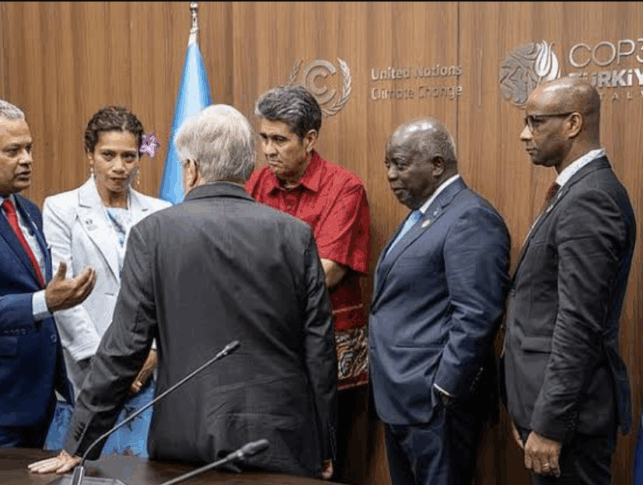
As negotiators gathered in Antalya for the final stretch of COP31, a second draft of the summit’s cover decision circulated on 19 November 2026, and it carried a significant omission. Gone were earlier references to moving away from fossil fuels. In their place, the Turkish presidency proposed a headline target: raise electricity’s share of global final energy consumption from roughly 23 percent to 35 percent by 2035. Seventy-five countries and ninety-four organisations have since signed the pledge, according to AllAfrica’s reporting on COP31 proceedings.
For African delegations, the numbers told a difficult story. The continent currently derives only around 12 percent of its total energy from electricity, well below the global average and far short of the proposed target. More than 560 million people in sub-Saharan Africa lacked access to electricity in 2024, per International Energy Agency data cited in AllAfrica coverage of the summit. Closing that gap within a decade would demand massive investment in generation capacity, grid infrastructure and new consumption patterns. The critical question hanging over Antalya was not whether the target was desirable but whether poor nations could pursue it without further straining public finances already under severe pressure.
The cost barrier is structural. The IEA has estimated that financing large-scale clean energy projects in Africa costs at least two to three times more than in wealthy countries or China, as reported by AllAfrica. For governments managing chronic fiscal deficits, that premium is not abstract. It directly shapes what any electrification pledge means in practice.
PACJA calls for grant-based financing over loans at COP31
On 19 November 2026, the Pan African Climate Justice Alliance (PACJA) delivered a statement in Antalya that cut through the summit’s technical language. The Alliance warned that COP31 risked closing without tangible gains for vulnerable communities and offered a pointed diagnosis: the climate financing gap is not a resource problem. Per AllAfrica’s coverage of the statement, PACJA frames it as the product of deliberate political choices about how global finance is structured.
The core of the objection is about form rather than volume. Existing mechanisms rely heavily on loans, often at commercial or near-commercial rates, which African governments must service regardless of whether a drought arrives or a cyclone hits. PACJA called for a shift toward grant-based financing, measurable fossil fuel reductions tied to clear timelines, and accountability frameworks with enforcement capacity. Augustine Njamnshi, speaking for the Alliance, argued that COP31’s success should be measured by its impact on vulnerable communities, not by another stack of pledges.
That argument is grounded in numbers that AfDB made public on 20 November 2026. In its latest macroeconomic report, the bank revealed that as of July 2026, fourteen African countries were at high risk of debt distress and eight were already in distress, largely because rising debt-service obligations have compressed fiscal space across the continent. For these governments, additional borrowing to build power infrastructure is not a neutral policy choice. It directly reduces what can be spent on health, food security and social services.
The cover text’s proposal to triple adaptation finance to at least 120 billion US dollars annually by 2035 is significant on paper. Whether that envelope materialises as grants or as new debt instruments will determine whether African states can absorb the funds productively or whether they deepen a cycle of climate-driven borrowing. That question remained unresolved as of the latest draft.
India’s decision not to sign the voluntary electricity pledge reflects separate concerns about applicability and fairness. That a large middle-income economy is also hesitating signals that the target’s credibility depends entirely on the financing architecture that accompanies it, an observation that reinforces, rather than duplicates, the African position.
What AfDB and African institutions are already deploying
What distinguishes the African position in Antalya is that it is not merely reactive. Alongside the criticism, concrete alternatives are already being implemented through African institutions.
AfDB Senior Vice President Marie-Laure Akin-Olugbade told world leaders at COP31 that more than 42 million Africans are now better protected against extreme weather through AfDB-backed early warning systems, according to AllAfrica’s report on the bank’s intervention. The bank’s Climate Action Window, established during the 16th replenishment of the African Development Fund, holds an initial portfolio of 41 projects worth 321.75 million US dollars, aimed at extending early warning coverage to twelve countries and rehabilitating 344 weather, climate and hydrological stations. In Freetown, Sierra Leone, a 5 million US dollar grant from the same window is modernising flood mapping and early warning infrastructure for approximately 700,000 residents.
AfDB’s Africa Disaster Risk Financing Initiative (ADRiFi), implemented alongside African Risk Capacity, takes a different approach. A 35 million US dollar initiative covering Comoros, Djibouti, Somalia and South Sudan enables pre-arranged liquidity for governments in the drought-prone Horn of Africa, a region where drought affected at least 19.4 million people between October 2020 and December 2022. Rather than waiting for emergency funding to arrive after a crisis peaks, governments participating in ADRiFi have resources available before the worst hits.
This gap between what African institutions are already deploying and what COP31 negotiators are committing to finance is the summit’s defining tension from the continent’s perspective. PACJA is not opposed to the electrification target as such. It is insisting that the global architecture must catch up with what African communities actually require: accessible, non-debt-creating finance built around local conditions rather than a universal framework calibrated to wealthier economies. With twenty-one issues reportedly unresolved as of 19 November and the summit approaching its close, the final hours in Antalya will test whether a conference that opened with ambitious energy language can deliver something more than a framework that looks transformative on paper but lands as new debt on African balance sheets.