
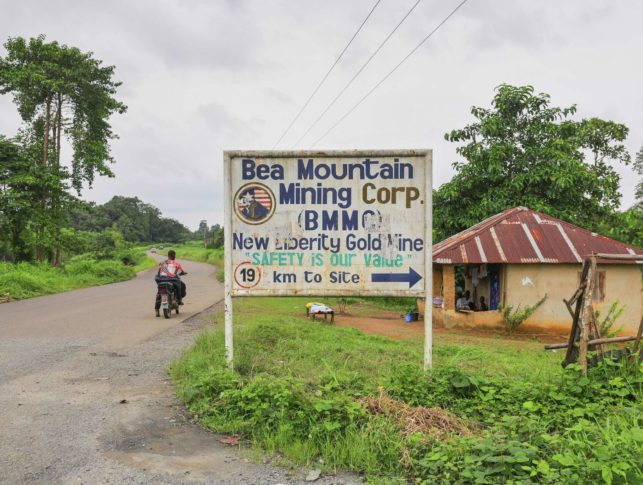
On 22 November, Liberia’s Interministerial Concession Committee delivered the Master Infrastructure Development Agreement (MIDA) to President Joseph Nyuma Boakai Sr., completing months of negotiations with Bea Mountain Mining Corporation (BMMC). The formal signing is scheduled for 25 November, after which the agreement moves to the Liberian Legislature for ratification. At US$5.7 billion, it is one of the most ambitious infrastructure commitments in Liberia’s post-war history.
The agreement’s scope extends well beyond the access roads and captive power plants that typically accompany a mining concession. Under the MIDA, Bea Mountain is expected to finance and build four power plants with a combined capacity of 270 megawatts: three hydropower facilities and one biomass plant. The Mount Coffee hydropower plant, the backbone of Liberia’s national grid since its rehabilitation in 2016, generates roughly 88 megawatts at full capacity. Adding 270 megawatts of new generation would more than triple that figure, representing a step change in the country’s power economy.
Transmission infrastructure matches the ambition of the generation assets. Two 150-kilometer lines are planned: one connecting the new facilities to the Mount Coffee substation and another linking the Via hydropower plant to Nimba County, a region in the country’s interior with historically limited grid access. The 146-kilometer Liberia Development Road, a flagship highway designed to connect power plants to key administrative and commercial centers, completes the package. Together, these elements form an integrated corridor spanning western Liberia and reaching toward the northeast.
A new model in resource-backed infrastructure finance
What makes the Bea Mountain deal analytically significant is not simply its scale but the model it embodies. BMMC, which operates the New Liberty Gold Mine in Grand Cape Mount County and is Liberia’s largest industrial gold producer, is being repositioned as a co-architect of national infrastructure, using revenue from commodity extraction to cross-subsidize electricity and transport for the broader economy.
Resource-backed infrastructure finance of this kind is not unique to Africa, but the Liberian arrangement is unusually broad. Several African governments have attached infrastructure obligations to mining or petroleum concessions, reasoning that commodity revenues provide a credible repayment stream and that extractive companies already hold logistics and engineering capacity. What sets the MIDA apart is its reach: rather than a single access road or a captive power line serving the mine site, the agreement covers multiple generation technologies, national-scale transmission and a major public road. This repositions BMMC as something closer to an infrastructure developer with a long-term public mandate.
The Interministerial Concession Committee’s formal role in negotiating and presenting the agreement to the presidency underscores that this is a structured public-private arrangement, with direct implications for Liberia’s concession policy and the fiscal frameworks that govern its extractive industries. The Legislature’s upcoming vote will be an important signal of how much political consensus this model commands.
Power, roads and the questions still open
The projected power additions address one of the most persistent constraints on Liberia’s economic development. Chronic electricity shortages raise the cost of doing business and limit industrial output, while also restricting access to social services. If the four planned plants are built on schedule and transmission lines reach Nimba County as designed, the effect on households and firms could be substantial, reducing dependence on expensive diesel generation and enabling new activity in sectors including agro-processing and light manufacturing.
Road connectivity carries similar promise. High transport costs in Liberia’s interior have long suppressed agricultural trade and limited market access, adding friction at every step of the supply chain. The 146-kilometer Liberia Development Road, running through areas linked to the mine’s operational footprint, is positioned to change that calculus, though its final routing will determine how widely the benefits reach surrounding communities.
These ambitions come with real questions. At US$5.7 billion over what is likely a multi-decade horizon, the deal’s value depends on how milestones are defined and how construction risk is allocated between the company and the state. It also depends on what happens to Bea Mountain’s obligations if gold prices fall or the mine’s operational life contracts. Environmental standards for three hydropower plants and a biomass facility will need to meet both Liberian regulatory requirements and international best practices, particularly around downstream water users and ecosystem health. Tariff and toll structures will shape whether the infrastructure ultimately serves a broad public or primarily benefits the mine and its suppliers.
Public debate has already surfaced, with some Liberian voices raising governance and equity concerns about the terms of the arrangement, as reported by AllAfrica. The Legislature’s ratification process offers an opportunity to scrutinize those terms before they become binding.
Liberia as a test case for West African infrastructure strategy
This deal arrives at a moment when African governments are actively seeking alternatives to donor grants and multilateral loans to close persistent infrastructure gaps. Resource-backed concession models offer one such alternative, particularly for countries with significant mineral endowments but constrained fiscal space. If the MIDA delivers on its commitments, it could serve as a reference point for other West African states weighing similar approaches in gold, iron ore and bauxite concessions.
The formal signing on 25 November and the Legislature’s subsequent deliberations will be the next milestones to watch. For now, Liberia has placed a large and consequential bet on the idea that a mining company can help power a nation.