
A Crisis That Became a Catalyst
Three years after Houthi attacks on commercial shipping triggered a mass rerouting of vessels away from the Red Sea, the scale of the structural change is becoming measurable. According to data from BIMCO cited by Trade Finance Global, container ship transits through the Red Sea and the Suez Canal fell by more than 60% from their 2023 levels. The vessels that chose the Cape of Good Hope route added roughly one to two weeks of voyage time and approximately one million dollars in extra fuel costs per trip. Daily commercial vessel traffic around the Cape averaged 20 ships between March and late April 2026, up from just six in 2023, according to IMF data cited in ACCA’s AB Magazine.
For Egypt, the impact was direct and severe. Suez Canal revenues, a critical source of foreign exchange, collapsed as traffic dried up. For ports along Africa’s southern and eastern coastlines, the sudden surge in vessel calls exposed structural bottlenecks that existing capacity could not absorb.
A partial normalization is now underway. Maersk, Hapag-Lloyd, and MSC have each announced that select services will return to Red Sea transits as security conditions partially stabilize. The Suez Canal Authority recorded a 54% year-on-year rise in net tonnage for the first eight months of 2026. But as Ecofin Agency reported in October 2026, Lloyd’s List Intelligence counted just 184 container-ship transits through Suez in August 2026, against 549 in August 2023. The crisis lasted long enough to redirect investment capital into African port infrastructure at a pace that will outlast the security situation that triggered it.
Gulf Operators Lock In Long-Term Positions Across African Ports
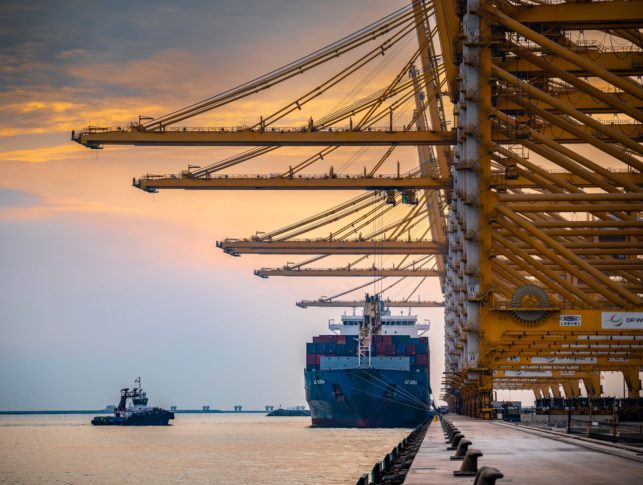
DP World, the Dubai state-linked logistics operator, launched a direct shipping route between Jebel Ali and Berbera in Somaliland in October 2025. Operating on a nine-day cycle with stops at Aden and Djibouti, the service connects the UAE’s flagship hub directly to the Gulf of Aden and opens a faster corridor into landlocked Ethiopia, an economy of more than 130 million people. Beyond East Africa, DP World is developing a deep-sea port at Ndayane in Senegal and a major terminal at Banana in the Democratic Republic of Congo, as part of a commitment to invest three billion dollars in African port and logistics infrastructure over the next three to five years, according to Trade Finance Global.
Abu Dhabi’s AD Ports Group is building its African portfolio through a parallel strategy. The group secured an 81% ownership stake in Luanda’s multipurpose terminal under a 20-year concession and holds a 30% stake in the Dar es Salaam container terminal in Tanzania through a joint venture with Adani Ports and East Harbour Terminals. In August 2025, AD Ports also signed an agreement with Angola’s trade regulator, ARCCLA, to develop a digital Single Logistics Trade Window, alongside a six-million-dollar expansion of its local truck fleet under the Noatum Unicargas Logistics subsidiary. For 2026, the group has budgeted AED 2.45 billion (approximately 667 million dollars) in port infrastructure capital expenditure, according to its own investor presentations.
The investment logic extends well beyond the current security situation. Concessions running 20 to 30 years give Gulf operators direct control over terminal operations, replacing a model built on short-term agreements. Gulf states are no longer just acquiring stakes in African assets: they are assuming operational responsibility for the corridors that link African producers to global markets.
The Efficiency Gap African Ports Must Now Close
The scale of Gulf investment is not matched by uniform port performance across the continent. Wait times for vessels to offload cargo at Dar es Salaam can stretch to five days, compared to 1.25 days at Kenya’s Port of Mombasa, according to Trade Finance Global. That differential matters to shippers calculating total logistics costs and limits how much traffic a port can retain once the Red Sea becomes viable again.
Sameer Bhatnagar, global head of ports at KPMG, outlined the risk in ACCA’s AB Magazine in May 2026: “Without addressing these constraints, increased shipping volumes risk translating into congestion and higher logistics costs rather than economic benefit.” His list of urgent investment priorities included deep-water berths, port rail corridors, and digital upgrades to reduce cargo dwell times.
Ebrima Sawaneh, group COO and CFO at Arise Ports and Logistics, which manages concessions across West Africa, gave a candid sector-wide assessment: “A few African ports are clearly world class or close to it, but many others are still constrained.” If efficiency gaps persist, the traffic diverted from the Red Sea becomes a temporary windfall rather than a platform for lasting competitiveness.
The potential upside of closing those gaps is substantial. Trade Finance Global estimated that efficiency improvements across African port infrastructure could yield up to 5.3 billion dollars in total logistics-chain savings.
Infrastructure Arriving Before the Institutions
The corridors, terminals, and digital customs systems now under construction will be operational long after current Red Sea security dynamics have resolved. The Jebel Ali-Berbera route, the Ndayane deep-sea terminal, the Banana port in the DRC, and the Angola digital trade window are commitments locked in by operators working on generational time horizons.
For African coastal states and their regional bodies, the pressing question is whether institutional frameworks can be upgraded to match the capital now arriving. Customs harmonization between neighboring port states, accelerated port authority reform, and investment in port-adjacent rail infrastructure would all help domestic economies capture more of the value moving through their waters. The private capital is in place. The governance architecture to make full use of it is still being assembled, and the window to do so is not indefinite.