
The UAE’s $1 billion AI for Development initiative
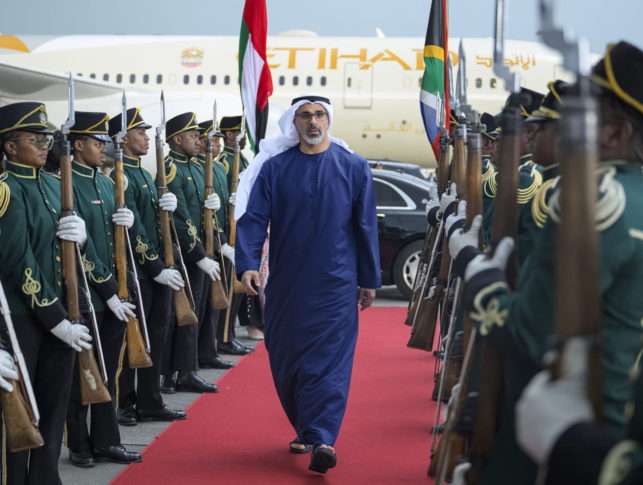
On 22 November 2025, Sheikh Khaled bin Mohamed, Crown Prince of Abu Dhabi, took the floor at the G20 Leaders’ Summit in Johannesburg with an announcement that cut through the usual summit communiqués. The UAE, he declared, would invest $1 billion across Africa to expand artificial intelligence infrastructure and AI-enabled services, in an initiative officially labeled “AI for Development.” UAE Minister of State Saeed Bin Mubarak Al Hajeri fleshed out the scope: the funds would provide African countries with access to computing power, technical expertise and global partnerships, with applications spanning education, agriculture, healthcare, digital identity, and climate adaptation.
The announcement was not a vague pledge. It followed years of concrete UAE positioning in global AI and data infrastructure. The country ranks second globally in artificial intelligence capability, according to a 2025 study by TRG Datacenters, and has spent heavily on building domestic AI capacity through state-backed entities such as G42, the Abu Dhabi-based group that has emerged as one of the most active AI companies outside of Silicon Valley. G42 has already moved into Africa, partnering with pan-African tech firm Cassava Technologies following a Microsoft-led investment deal in 2024. Its subsidiary, Khazna Data Centers, operates several of the UAE’s flagship facilities.
Africa’s data center market and the structural supply gap
The timing of the initiative aligns with an acute structural reality in Africa. According to a June 2026 report by research firm Arizton, the African data center market attracted $3.64 billion in investment in 2025 and is projected to reach $8.76 billion by 2031, expanding at a compound annual growth rate of 15.76 percent. South Africa, Kenya, Nigeria, and Egypt remain the main hubs, while Morocco, Ghana, and Tanzania are emerging as the next tier of investment destinations.
Yet demand is growing faster than supply. Analysts estimate that Africa needs approximately $6 billion in additional data center investment by 2030 to close the gap. That shortfall reflects not only the explosion of mobile internet use and fintech adoption, but also a new layer of pressure: governments across the continent are building digital public services, e-citizen platforms, and digital identity systems that require locally hosted, secure cloud infrastructure. Data localisation laws in several African states have created both a regulatory obligation and a commercial opportunity for locally anchored facilities.
That is where the UAE initiative enters a structurally receptive market. Computing power is the most cited constraint among African AI developers. Access to GPUs and high-performance compute consistently ranks among the top barriers in surveys of African tech ecosystems, alongside electricity and skilled labour. By framing the $1 billion around compute access, the initiative addresses a bottleneck that African entrepreneurs and engineers themselves identify as most pressing.
Partnership terms and local capacity building
The critical question for African stakeholders is not whether Gulf capital is welcome, but on what terms it arrives. Past infrastructure cycles on the continent left lessons about ownership concentration, technology lock-in, and limited local capacity building. The UAE’s framing as a “development” initiative, targeting public-service sectors rather than purely commercial hyperscaling, signals a deliberate positioning: this is not simply a commercial play for cloud revenues.
In practice, the architecture of the initiative will determine its impact. If computing infrastructure is deployed and operated exclusively by UAE entities, the developmental dividend remains limited. If it involves partnerships with African data center operators, local universities for technical training, and regulatory engagement with African digital authorities, the initiative could genuinely accelerate what African policymakers have long sought: a data-sovereign, locally managed layer of digital infrastructure.
There are early indications that the model at least partially favours local inclusion. Cassava Technologies, a pan-African tech firm, has already positioned itself as a continent-side partner in UAE-linked AI infrastructure deals, working alongside Microsoft and G42. In Kenya, plans for a geothermal-powered data center reflect both local energy innovation and an attempt to manage the power costs that remain a core challenge for African data infrastructure. These examples suggest that the Afro-Arab digital axis is being built through joint ventures rather than unilateral deployments, though the specifics of equity structures and technology transfer terms are rarely made public.
Deployment scale and what $1 billion can build across African markets
A billion dollars in AI infrastructure investment, deployed across a continent, can mean many things. At current data center construction costs, which Arizton estimates at $8 to $10 per watt in Egypt and somewhat higher in sub-Saharan markets, it could fund between 100 and 125 megawatts of new capacity, a meaningful addition to Africa’s current total of several hundred megawatts. Applied to smaller edge computing nodes and AI compute clusters, the same capital could serve many more localities and workloads, particularly if prioritised for governments and research institutions.
The selection of which countries, institutions, and sectors receive priority under the initiative will be as telling as the headline figure. If the UAE chooses partners based on digital governance maturity, existing AI policy frameworks, and willingness to open data centre markets to joint ventures, it will drive a certain set of outcomes. A purely commercial allocation would risk narrowing the initiative’s impact to a handful of markets already well-covered by private investors.
What is clear is that the G20 summit in Johannesburg gave the UAE a high-visibility platform to signal its ambition as Africa’s preferred Gulf partner in the AI era. For African digital economy actors, from regulators to startup founders, the initiative represents both an opportunity and a moment of negotiation: the chance to channel large Gulf capital into locally anchored infrastructure, on terms that expand African capability rather than simply outsourcing the continent’s digital future to a new external provider.