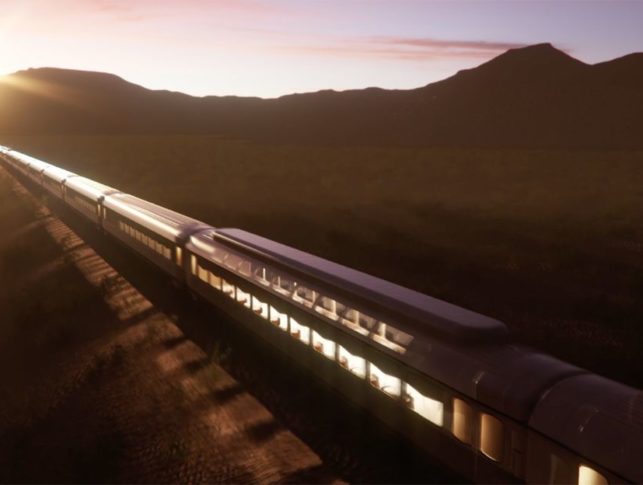
Saudi Arabia is betting on a slower, more exclusive way to travel. With Dream of the Desert, the Kingdom is launching its first luxury tourist train, a project that blends hospitality, mobility and nation branding into a single moving experience. Far from being a nostalgic nod to old-school rail travel, this train is a strategic business tool designed to attract high-value tourism and reinforce Saudi Arabia’s Vision 2030 ambitions.
Developed in partnership with Italian luxury brand Arsenale Group and operated on the Saudi rail network, Dream of the Desert is expected to run across the country’s northern routes, notably between Riyadh, AlUla and Qurayyat. The train will feature around 40 luxury cabins, including suites, lounges and dining cars, accommodating roughly 80 to 90 passengers per journey. This is not mass transport. It is scarcity by design.
A moving luxury asset in the middle of the desert
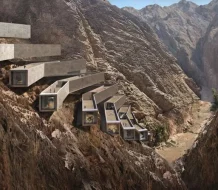
Dream of the Desert is conceived as a five-star hotel on rails. Interiors are inspired by Saudi architectural heritage, with contemporary design, panoramic windows and bespoke furnishings. Onboard services are expected to include fine dining, curated cultural content and guided off-train excursions, particularly in destinations like AlUla, one of Saudi Arabia’s flagship tourism projects.
From a business standpoint, the numbers are telling. Luxury train journeys elsewhere in the world often sell for between 2,000 and 5,000 dollars per person for multi-day experiences. Saudi Arabia is positioning itself in this premium bracket, targeting international travelers who are willing to pay for exclusivity, storytelling and comfort rather than speed. With limited capacity and high price points, profitability relies on margins, not volume.
The train also capitalizes on existing infrastructure. By upgrading and reimagining rail assets instead of building entirely new ones, the project limits capital expenditure while increasing the value generated per kilometer traveled. It is a classic example of asset optimization, applied to tourism.
Why this train fits Saudi Arabia’s long-term strategy
Dream of the Desert is more than a tourism product. It is a narrative device. For decades, Saudi Arabia has been associated with oil, aviation and road transport. A luxury train crossing the desert sends a different message: one of openness, refinement and experiential travel.
Tourism is expected to contribute 10 percent of Saudi Arabia’s GDP by 2030, up from around 3 percent a decade ago. The country aims to attract 150 million visitors per year by the end of the decade. While Dream of the Desert will only host a fraction of those travelers, its symbolic impact is disproportionate to its size. It helps position Saudi Arabia as a premium destination, not just a new one.
There is also a sustainability angle. Rail travel produces significantly lower CO₂ emissions per passenger than short-haul flights, especially for domestic routes. For a country under increasing pressure to demonstrate environmental responsibility, promoting luxury rail fits the growing global demand for slower, more conscious travel without sacrificing comfort.
The project has not been without controversy. Critics point to the optics of launching a luxury train in a country where questions around human rights, freedom of expression and labor conditions remain central in international debates. Others question the relevance of ultra-premium tourism in a region facing water scarcity and extreme climate constraints, arguing that luxury infrastructure in the desert risks amplifying environmental pressures rather than alleviating them.
There is also skepticism about demand sustainability: with limited global precedent for profitable luxury rail in harsh climates, some analysts wonder whether the project will attract enough repeat international travelers to justify long-term operating costs
In the end, Dream of the Desert is not about getting from point A to point B. It is about redefining what the journey itself is worth. By combining luxury hospitality, cultural storytelling and strategic restraint, Saudi Arabia is testing a simple but powerful idea: in a world obsessed with speed, slowing down can be a premium business.
Photos : cnn.com