
South Africa
Tag Archive

South African entrepreneur is first black woman to launch an airline

Comments (0) Africa, Business, Featured

Siza Mzimela

Siza Mzimela, a longtime aviation executive, is CEO of Fly Blue Crane, which operates flights to several locations in South Africa.

South African entrepreneur Siza Mzimela is making an important mark on aviation as the first black woman in the world to start an airline.

Mzimela is founder and CEO of Fly Blue Crane, a fledgling airline that flies to several destinations within the country and hopes to expand to regional cities.

Mzimela said she is tapping her years of experience leading other airlines, including South African Airways, the country’s largest airline, to shape Fly Blue Crane to meet customer expectations for consistent, on-time travel. The CEO promised convenient, problem-free booking and travel with competitive fares.

New airline is based in Johannesburg

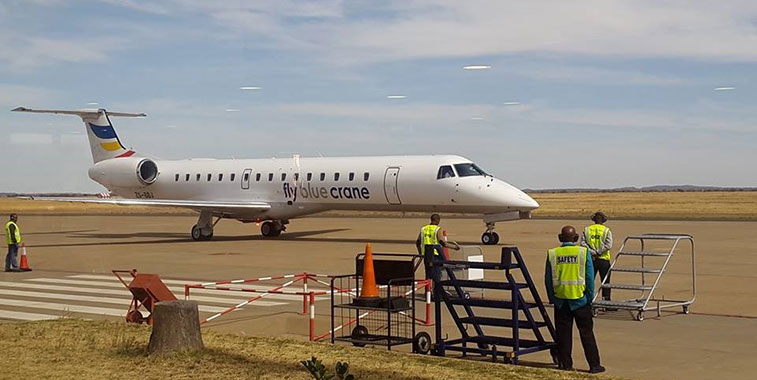
Blue Crane, based at O.R. Tambo International Airport in Johannesburg, launched in August offering several flights daily to Bloemfontein, Kimberley and Nelspruit.

Blue Crane later added flights between Kimberley and Cape Town and between Bloemfontein and Cape Town, but announced that flights to Nelspruit would be discontinued in January because of lack of capacity.

The airline hopes to find success serving provincial and regional capitals in southern Africa.

Mzimela said that airports in Johannesburg, Durban and Cape Town had more than enough air service. But Fly Blue Crane wants to fill gaps in the market in smaller cities such as Kimberley within South Africa and then expand to regional centers.

She wants to use the airline to open new routes that will help improve the economies of smaller markets, she said.
fly blue crane

Regional expansion is a goal

While service within South Africa is the immediate priority, the new airline wants to expand beyond those borders. Mzimela hopes to add destinations in Botswana, Namibia, Zimbabwe and the Democratic Republic of Congo.

Fly Blue Crane operates a fleet of four fuel-efficient 50-seater Embraer Regional Jet 145 aircraft, which enables quick turnaround and efficient crews.

The new company is taking off at a time when the airline industry in Africa is poised to expand. According to the African Airlines Association, there is opportunity for African carriers to expand intra-African and domestic travel for a growing middle class while global carriers dominate intercontinental travel. More than 20 carriers are based in South Africa, the largest being South African Airways with a fleet of 65 planes.

Founder has headed two other airlines

Launching an airline isn’t the first “first” for Mzimela.

She was the first female CEO at both South African Express Airways and South African Airways. At South African Airways, she introduced non-stop flights to New York and Beijing  – a first in the history of the airline.

Mzimela also was the first woman in 67 years named to the board of directors of the International Air Transport Association. She serves on the South African Tourism Board and is a member of the board of the Oprah Winfrey Leadership Academy for Girls.

In 2012, she was named one of the 10 Greatest Female Leaders in Africa Today by Ventures Africa.

Mzimela also founded Blue Crane Aviation, an aviation services company providing African airlines with consulting, and legal and aircraft management services. She serves as the company’s executive chairperson.

She graduated with a degree in economics and statistics and began her career in banking before moving into the airline industry as a researcher.

Few women rise to the top in the airline industry

Mzimela said being a woman executive in the aviation industry has posed challenges. Globally, only 12 of 248 airline CEOs are women, fewer than 5 percent. Sexism and lack of female mentors are cited as factors that hold women back from executive posts.

“I don’t know how many times I walked into meetings and people just assumed I probably was the one who was going to be taking notes,” she said.

Mzimela said her success managing established companies motivated her to want to “build something better from the ground up.”

Read more

South Africa’s MTN aims to settle Nigerian fine out of court, shares jump

Comments (0) Africa, Business, Latest Updates from Reuters

JOHANNESBURG (Reuters) – A judge has given South African telecoms company MTN Group until March to try to reach a settlement with the Nigerian authorities over a disputed $3.9 billion fine, sending its shares 8 percent higher.

The Nigerian Communications Commission (NCC) imposed the penalty on MTN last year for failing to disconnect users with unregistered SIM cards.

Nigeria has been trying to halt the widespread use of such SIM cards amid worries these are being used for criminal activity, including by the militant Islamist group Boko Haram.

MTN has been lobbying against the fine and has already seen it cut from an initial figure of $5.2 billion.

The judge at the Federal High Court in the Nigerian city of Lagos on Friday adjourned the case until March 18 to allow the parties to try to reach an agreement, MTN said in a statement.

The prospect of a lower fine boosted MTN shares.

Dobek Pater, the managing director of research group Africa Analysis, estimated that a fine that could satisfy both parties would between $1 and 2 billion.

MTN, which is led by Executive Chairman Phuthuma Nhleko makes about 37 percent of its revenue from Nigeria, and the current fine equates to more than twice its annual average capital spending over the past five years.

Nhleko was put in charge for up to six months in November to help to steer the company through the crisis.

The group is also fighting allegations for not paying tax in Cameroon..


(Reporting by Thekiso Anthony Lefifi; Editing by Keith Weir)

Read more

South Africa’s Finmin says new investment law no ‘deal-breaker’

Comments (0) Africa, Business, Latest Updates from Reuters

JOHANNESBURG (Reuters) – South African Finance Minister Pravin Gordhan on Thursday defended a controversial investment law, saying investors had nothing to fear.

Pretoria let bilateral treaties agreed with European nations shortly before the end of apartheid lapse in 2013, triggering concern among foreign investors over whether the replacement law will offer the same protections.

President Jacob Zuma signed the Promotion and Protection of Investment Bill into law last month. The law would come into force on a date yet to proclaimed by Zuma.

Finance Minister Pravin Gordhan, reappointed last month after a bungled cabinet reshuffle, told 702 Talk Radio investors would be adequately protected.

“I don’t think it should be a deal-breaker because we provide world-class investment protection,” Gordhan is qouted as saying.

The law rolls over existing guarantees against state seizure of assets from a raft of individual, 20-year old treaties but removes the explicit possibility of recourse to international arbitration in the event of a dispute.

European nations affected by the lapse in bilateral treaties include Germany, Spain, Belgium and Switzerland.

Europe accounts for around three-quarters of all foreign direct investment in South Africa, although Pretoria has been pushing hard to attract capital from other big emerging markets such as China.


(Reporting by Tiisetso Motsoeneng; Editing by Kim Coghill)

Read more

South Africa’s Kumba Iron Ore tells union to brace for lay-offs

Comments (0) Africa, Australia, Latest Updates from Reuters

JOHANNESBURG (Reuters) – Kumba Iron Ore has told South Africa’s National Union of Mineworkers (NUM) it will issue lay-off notices this year if low prices persist for the steel-making ingredient, the union’s general secretary said on Wednesday.

“The price has put them in dire straights and there is a prospect of them issuing a Section 189 notice at Sishen mine,” NUM General Secretary David Sipunzi told Reuters.

He was referring to the regulatory process South African employers must follow before they lay off staff.

“They have been trying to sensitise us to this possibility. If the price remains like this for a few months they will have no choice but to issue a Section 189,” he said.

Officials from Kumba were not immediately available for comment.

The group has said it plans to reconfigure its Sishen mine, the largest iron ore operation in Africa, and was targeting 2016 production there of 26 million tonnes, down from a previous guidance of 36 million tonnes.

Lay-offs are a politically thorny issue in South Africa, where the jobless rate is around 25 percent and local elections are expected this year. The NUM is also a key political ally of the ruling African National Congress (ANC).

Sipunzi said he expected to see more lay-off notices this year from other sectors but the union wanted to work with companies to find ways to minimise job cuts.

In line with other commodities, prices for iron ore have been sliding due to oversupply and and slowing economic growth in China, the world’s bigest metals consumer.

Mining giant BHP Billiton said on Wednesday that it saw no recovery in iron ore or coal prices in the next few years.


(Reporting by Ed Stoddard; Editing by James Macharia)

Read more

Strong India, Africa demand lifts South Africa 2015 coal exports

Comments (0) Africa, Business, Latest Updates from Reuters

RICHARDS BAY, South Africa (Reuters) – Coal exports from South Africa’s Richards Bay Coal Terminal (RBTC) rose by 5.7 percent to 75.4 million tonnes in 2015 helped by demand in Africa and India.

Africa’s largest coal export facility, a major supplier to Europe and Asia, RBCT had set a target of 75 million tonnes and aims for similar results in 2016.

“Its going to be hard to beat 75 million tonnes, because of where prices are sitting this year,” Chief Executive Nosipho Siwisa-Damasane told a news conference.

Shipments to Africa and India rose sharply, offsetting a fall in demand from Europe and from China, where RBTC said it did not send a single vessel in 2015.

Coal prices have tumbled in recent years due to a glut of supply and weaker demand growth, pushing some producers to curtail activity, sell or shut coal mines.

RBCT, which moves the commodity on behalf of producers and shareholders such as Exxaro and Anglo American, said it had shelved expansions plans due to weak prices.

RBTC had planned to increase its capacity to 110 million tonnes from 91 million tonnes.


(By Zandi Shabalala. Reporting by Zandi Shabalala; editing by James Macharia and Jason Neely)

Read more

South Africa’s net reserves tick up to $40.654 bil in December

Comments (0) Africa, Business, Latest Updates from Reuters

JOHANNESBURG (Reuters) – South Africa’s net gold and foreign exchange reserves were at $40.654 billion in December, up slightly from $40.471 billion in November, Reserve Bank data showed on Friday.

Gross reserves also edged higher to $45.787 billion from $45.14 billion previously. The forward position, which represents the central bank’s unsettled or swap transactions, dropped to $1.424 billion in December versus $2.106 billion.


(Reporting by Stella Mapenzauswa; Editing by Himani Sarkar)

Read more

Phuti Mahanyele: an inspirational black business woman

Comments (0) Africa, Featured, Leaders

Phuti Mahanyele

Phuti Mahanyele – an inspirational black business woman who believes that the poor representation of women in the boardroom of major businesses in the private sector is “not just a social injustice but an economic and business imperative”.

Phuti was born in Dobsonville, Soweto, South Africa on March 15th, 1971, however she largely grew up in the Claremont township outside Durban. Her mother died at the age of 42 in 1989 when Phuti was 17. Phuti has since acknowledged that this was a major turning point in her life as it made her for the first time realize how short life can be and why it is therefore so important to never take it for granted.

Throughout her life her parents continuously advocated the importance of education, never differentiating between their sons and Phuti and her two sisters.

Her father: a pioneer for the improvement of black education

Her father, Professor Mohale Mahanyele, was a successful business man and pioneer for the improvement of black education. Whilst the Chairman of the National Economic Education trust, he ensured that thousands of young people progressed into tertiary education. Throughout his life he refused to accept the fact that just because a child came from a home with insufficient funds to afford expensive higher education fees, they were not entitled to it. During his life he could have become one of South Africa’s richest men however he was never interested in making easy money, and instead believed in reinvesting both his money and time back into the people and places he loved.

Phuti was educated in Johannesburg until she was 17, at which point she moved to the United States where she attended Douglass College in New Brunswick, New Jersey. In 1993 she graduated with a degree in Economics and then went to De Montfort University in the United Kingdom where she obtained an MBA on “The Impact of International Trade on Black Economic Empowerment.” Her education didn’t end here because in 2008 she completed a course called “Global Leadership & Public Policy in the 21st century” at Harvard University.

Early career

Phuti’s first job was at her father’s company, National Sorghum Breweries, however whilst she admits to being very happy at this time of her life, she also confesses to feeling unfulfilled. After two failed applications she finally won an internship at Fieldstone – an investment banking firm in New York. After a difficult start, she flourished and achieved the position of Vice President before leaving 7 years later, at which time she moved back to South Africa.

Her next job, running the Project Finance Unit for the Development Bank of Southern Africa proved to be less successful and she left after only a few months. Looking back, she admits that it was a bad fit for her and not an environment she could continue to work in.

Whilst looking for other work she received a telephone call from Cyril Ramaphosa, the Chairman of a then relatively small company called “New Africa Investments” which became the Shanduka Group.

Shanduka Group

Phuti originally joined as the managing director of Shanduka Energy in 2004 and eventually went on to become the CEO of the Shanduka Group. It was whilst working there that she truly found her passion.

She has since admitted to finding Cyril so inspirational on their first meeting that she agreed to work with him even before she knew what the job and salary was.

Phuti speaks of the amazing culture and work ethic at the Shanduka group, admitting that Cyril’s astonishing humility and ability to inspire was fundamental to this. She has always felt hugely responsible and accountable to her community and working at the Shanduka Group allowed her for the first time to give something back, as the company, unlike so many others, didn’t just focus on the profit for shareholders.


Business pillars and key successes

Phuti adheres to 3 business pillars: understanding herself including her spiritually; understanding any issues affecting her staff, personal and professional; and ensuring she has all the information she needs at all times in order to be able to drive the business forward

When appointed CEO, her key priority was to ensure that the business moved some of its investments into areas that were less market sensitive, as she saw this as a way of ensuring the growth and security of the company’s investments in years to come. During her time at Shanduka she helped increase the company’s net asset value to approximately R8billion. Major deals driven by Phuti with Coca-Cola and McDonald’s were key to this success.

After 10 years at the Shanduka Group, Phuti has achieved a lifelong ambition and with the support of her business partner Jeremy Katzen, a highly experience banker from Johannesburg, has launched her own investment company called Sigma Capital.

Major influences on her life

Phuti often cites her family, notably her father as a major influence in her life, however she also frequently talks about the huge impact Cyril Ramaphosa has had on both her business and professional life.

Her parents taught her how to see beyond problems and challenges and to remain positive at all times. Phuti believes that every single person on earth has a purpose and that they are obligated to discover what it is and then achieve it.

Life changing experience

Whilst attending a meeting in London, in 2013 Phuti was experiencing severe headaches, however she assumed it was just due to tiredness and tension. Whilst out shopping after the meeting she fainted, it was at this time she first sought medical attention. She was told to rest and returned to South Africa the following day, however on arrival she ignored the advice and went back to work where she then fainted again. When she woke up in hospital she was surrounded by friends and family, all of whom she didn’t recognize. It was at this time that she was told that she’d actually suffered from a stroke, hence her loss of memory.

Although she has now made a full recovery, the experience has changed her. Whilst she still has her incredibly high work ethic and puts in long hours, she is now also committed to finding a better work/life balance by valuing the importance of friends and family and not just achievements. She is in fact now engaged again (having already been divorced twice), and is learning to cook and play the piano. She admits to being excited and is looking forward to being a better wife and stepmother. “I feel ready to be a wife now”, she said.

When Phuti was asked what she would most want to be remembered for she said, “for having given as much of myself as I possibly could”.

Read more

Nigeria orders MTN to pay $3.9 bil fine by Dec 31

Comments (0) Africa, Business, Latest Updates from Reuters

ABUJA (Reuters) – South African mobile phone operator MTN will have to pay a $3.9 billion fine imposed by Nigeria for failing to disconnect users with unregistered SIM cards by Dec. 31, a source in the Nigerian telecommunications regulator said on Wednesday.

Nigeria’s telecoms regulator had cut the fine from an initial $5.2 billion after weeks of lobbying by Africa’s biggest mobile phone company to get it reduced.

“Appropriate action will be taken,” should MTN fail to meet the deadline, the source said, asking not to be named and giving no further details.

MTN said this month it would challenge the decision in court.

Nigeria has been pushing telecoms firms to verify the identity of subscribers amid worries unregistered SIM cards were being used for criminal activity in a country facing the insurgency of militant Islamist group Boko Haram.

The fine came months after Muhammadu Buhari swept to power in Africa’s biggest economy following a campaign in which he promised tougher regulation and a fight against corruption.


(Reporting by Felix Onuah; Writing by Ulf Laessing, editing by William Hardy/Keith Weir)

Read more

Bargain buying lifts South Africa’s stocks, rand weak

Comments (0) Africa, Business, Latest Updates from Reuters

JOHANNESBURG (Reuters) – South African stocks rose to a more than two-week high on Tuesday, bolstered by bargain hunters and a recovery in oil prices from its lowest level in more than a decade, while the rand dipped in holiday-thinned trade.

The benchmark Top-40 index rose 1.2 percent to 44,900.59, while the broader All-Share index rose by the same margin to 49,780.33.

“What we are seeing is a bit of buying before the close of the quarter,” said Sanlam Private Investments’ portfolio manager David Peacock. “Some stocks were oversold, so now we are seeing some nibbling [back].”

A recovery in oil prices from 11-year lows as investors unwounded some of their bearish bets on the battered commodity also helped boost stocks such as petrochemicals company Sasol, which rose by 2.61 percent to 393 rand.

Other gainers included Africa’s largest mobile operator MTN, which gained 4.53 percent to 141.16 rand, while its rival, Vodacom added 2.34 percent to 151.72 rand.

Among the losers was Tiger Brands, which fell 1.81 percent to 318.00 rand.

Trade was light, with 153 million shares changing hands on the stock market, according to preliminary bourse data, well below the average of 183 million shares.

On the forex market, the rand weakened in shallow, range-bound trade following its brief relief rally ahead of the holiday season.

Trade is expected to be subdued for the remainder of the year as most domestic market players are on holiday, and with no major economic news to provide direction for the rand.

By 1523 GMT the rand had weakened 0.49 percent to 15.1700 per dollar compared to 15.1030, where it closed overnight in New York.

“We expect the rand to hover around R15/$ for the rest of the year,” said NKC African Economics analyst Bart Stemmet. “We see risks to the rand at its current levels to be balanced.”

Government bonds were weaker, with the benchmark paper due in 2026 adding 9 basis points to 9.445 percent.


(Reporting by Nqobile Dludla and Thekiso Lefifi; Editing by Ed Stoddard)

Read more

South Africa white maize at record high, drought concerns mount

Comments (0) Africa, Business, Latest Updates from Reuters

JOHANNESBURG (Reuters) – Mounting jitters about a searing drought pushed South African white maize prices to record highs on Friday and traders said the ceiling had not been reached as farmers fail to plant in the Free State province.

The rand’s plunge to record lows has also spurred the rally, which has serious implications for the inflation outlook in Africa’s most advanced economy as white maize is the main source of calories for lower-income households.

South Africa’s central bank, which is in a tightening cycle, has repeatedly voiced concern about the drought and food prices.

The December white maize contract, which expires next week, was 0.6 percent higher at 4,140 rand a tonne after scaling a peak of 4,160 rand, according to Thomson Reuters data.

“Some relief rain fell yesterday and last night but it is still too little in the Free State and there are still farmers there who have not planted yet,” said Piet Faure, a trader at CJS Securities.

The weather forecast for the next two weeks in maize-growing areas of the Free State is also not good, traders said. Farmers who have not yet planted will soon run out of time to do so.

An El Nino weather pattern has exacerbated the drought and follows a bad last harvest when dry conditions shriveled the crop by a third to 9.94 million tonnes, the lowest since 2007.


(Reporting by Ed Stoddard; Editing by Ed Cropley)

Read more